
Start with what your facility needs to keep running
Backup power starts with a business decision: which operations must continue, and how much interruption can each tolerate? A permanent generator, an automatic transfer switch and a temporary generator connection solve different parts of that problem.
Halo Electric provides permanent generator installation, automatic transfer switch installation and replacement, temporary generator connections, and generator rental coordination for Southern California facilities. Bring your current power concerns and future plans into the same conversation.
What does an automatic transfer switch do?
An automatic transfer switch (ATS) moves selected electrical loads between a normal supply and an alternate supply. In a typical utility-and-generator arrangement, the controls detect a utility failure, initiate generator startup and transfer the loads once the alternate source is acceptable. They transfer back after normal power returns and the configured conditions are met.
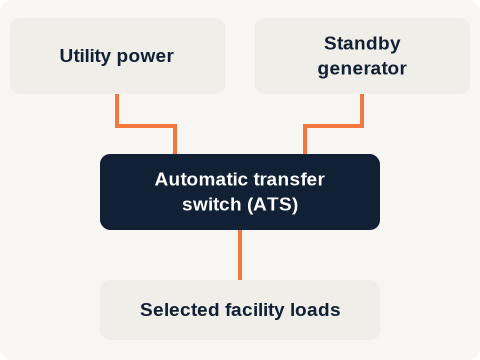
An ATS is not an uninterruptible power supply (UPS). Loads may lose power while the generator starts and the transfer occurs. Equipment that cannot tolerate that gap needs a separately planned ride-through solution.
Permanent standby or temporary power?
Permanent standby power keeps a generator on site, ready for the designed operating sequence. Temporary power brings in a mobile generator for an outage, repair or planned shutdown. It needs a suitable connection arrangement and an operating plan; a rental reservation alone does not make a building ready.
A purpose-built quick-connect arrangement can provide a connection point for temporary equipment. Transfer and isolation equipment must suit the facility; connectors alone do not provide automatic transfer or prevent backfeeding.
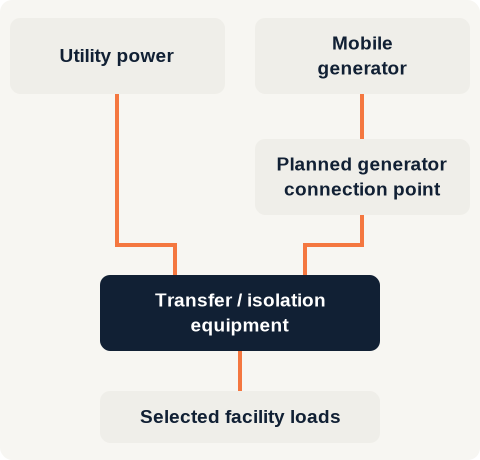
For a temporary-power request, identify who will coordinate delivery, equipment access, fuel support, the connection work and return to normal service. Confirm equipment availability and the scope of each party’s work before relying on a proposed schedule.
Which transfer arrangement fits the facility?
Open-transition equipment disconnects one source before connecting the other. Closed-transition equipment briefly overlaps sources under suitable conditions and requires utility coordination and approval when paralleling with the utility. It does not eliminate generator startup time after an outage.
Bypass-isolation equipment provides another path for the load so the transfer switch can be isolated for service. More complex facilities may use multiple utility or generator sources. Eaton’s ATS fundamentals guide explains these options in more detail.
What to gather before a generator or ATS installation
- Priority loads: list the operations that need backup and those that can remain off.
- Existing information: gather available electrical drawings, equipment schedules and past service reports.
- Load behavior: include motor starting, equipment sequencing and sensitive electronics—not just running power. A load study may help establish the existing demand.
- Site logistics: identify available space, delivery access, occupied areas and acceptable shutdown windows.
- Responsibilities: agree who handles equipment supply, electrical work, other required trades, permits, startup, testing and ongoing support.
Generator sizing must account for how loads start and operate. A switchboard’s amp rating alone does not establish the required generator size. The proposed system also needs a review of voltage, phase, equipment ratings, grounding and protection for the actual installation.
See Halo’s backup-power services in the field
Halo’s Pro Care team handles permanent generator installation, ATS installation and replacement, temporary generator connections and generator rental coordination.
Our project examples include an emergency dispatch connecting a temporary 500 kW generator to a senior living facility’s switchboard, and a 2,000-amp automatic transfer switch installation at a cold storage facility in Corona, California.
Explore Pro Care’s backup-power services and project photographs.
Plan your next step with Halo
For a planned generator or ATS installation, tell us about the property, the equipment you need to support and your project timeline. For an urgent temporary-power need, call 714-831-1008 and describe the affected facility and current power situation.
Halo’s Pro Care team offers 24/7 emergency electrical service across Orange, Los Angeles, Riverside and San Bernardino counties. Equipment availability, site conditions and the required work determine the response plan.
Sources & further reading
- Eaton: Fundamentals of Automatic Transfer Switches
- Eaton: Heavy-Duty Quick-Connect Safety Switches
- Cummins: Transfer Switch Application Manual (PDF)
- Cummins: Liquid-Cooled Generator Set Application Manual (PDF)
This guide supports project planning. Equipment requirements and inspection decisions depend on the installation and the applicable authority. Have qualified professionals assess your facility’s specific conditions.